
• About
    • Mission & Vision
    • Our Leadership
    • ADF: A Druid Fellowship
    • Photos
  • Services
  • Calendar
  • Resources & Social Justice
  • Membership
  • Blogs
    • Prairie Tidings (Church Blog)
    • Rev. Badger's 2019 Stoic Blog
    • The Practical Bard (Rev. Missy's Blog)
    • Little Druid on the Prairie (Rev. Lauren's Blog)
  • Policies
  • Contact Us
  • About
    • Mission & Vision
    • Our Leadership
    • ADF: A Druid Fellowship
    • Photos
  • Services
  • Calendar
  • Resources & Social Justice
  • Membership
  • Blogs
    • Prairie Tidings (Church Blog)
    • Rev. Badger's 2019 Stoic Blog
    • The Practical Bard (Rev. Missy's Blog)
    • Little Druid on the Prairie (Rev. Lauren's Blog)
  • Policies
  • Contact Us
Mountain Ancestors Grove, ADF

A Year of Contemplation

Heroes, Here and Now (Day 294)

10/21/2019

 
Picture
Image by productionpollockco from Pixabay

Such behavior! People don’t want to praise their contemporaries whose lives they actually share, but hold great expectations for the praise of future generations - people they haven’t met or ever will! This is akin to being upset that past generations didn’t praise you.”
Marcus Aurelius, Meditations, 6.18

In certain branches of paganism/polytheism, there exists a trope about doing good, important, honorable things in the now so that our memory and spirit, as it were, can live on. Live to be worthy of being an Ancestor, one remembered and venerated by future generations. 

This may be an unpopular opinion, but I just have to say, when it comes to the subject of “why be the best person we can be,” who gives a crap about the opinions of future people? What a waste of our minds, bodies, and hearts… living for something that doesn’t actually exist. The future, because of its inherently speculative nature, exists only in our heads. What I’m saying is: our mindfulness isn’t most effective in the future. 

If we can manage to get out of our own heads long enough to BE in the present moment, oftentimes we’ll notice how many opportunities to engage with virtue and kindness are all around us in each consecutive little blip of time. Each heartbeat contains infinite possibilities to do good in the now… 

… past and future heartbeats don’t matter. 

What are we doing with this one? 

… already gone. THIS one?!

… gone. 

Do good in the NOW. 

Be the hero the moment needs. 

(See y’all tomorrow)

Marks of the Good Life (Day 293)

10/20/2019

 
Picture

​We’ve all, at one time or another, been in a place where it seems nothing is left but to wonder what’s the meaning of “all this”? You know… the meaning of life. WHY we were put here on earth? 

So many answers. So many. So many possibilities… all seen through one lens. The life lens. 

Stick with me for a minute. What would happen if it were not we who were asking these questions to the abyss, Sacred Fire, idols, symbols, deities, Ancestors, or seeking these answers in omens… 

… but instead, we were being asked these questions by something/someone beyond us. We’re not ASKING the questions to that which is beyond us, we’re the ones being ASKED the questions...

… how we live is the answer. 

We can try to sell it in all sorts of packaging and wrapping, but ultimately, it is what it is. 

If we want the gift to stand on its own without relying on the wrapping, only we can make it so. 

Live a different answer. 

(See y’all tomorrow)

Good Habits Drive Out Bad Habits (Day 292)

10/19/2019

 
Picture
Image by marekuliasz from Canva.com

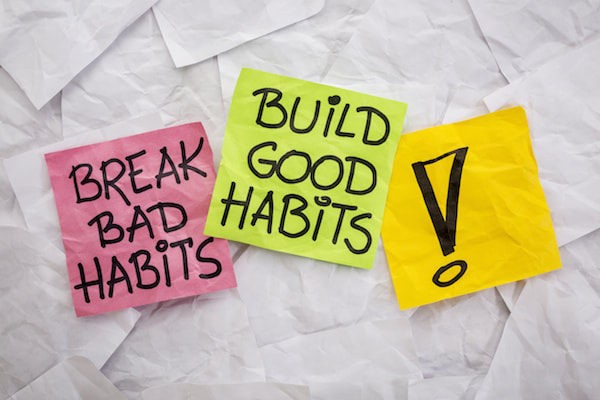
This is a hard topic, at least how it’s presented above. 

It seems very straightforward, but all black and white, dualistic things seem very straightforward. There isn’t a lot of room for nuance or unique circumstance, not to mention shades, hues, and colors. Habituation, like the rest of reality, is a lot more complex than we’d like to believe, and we relate to simple things as much less intimidating when compared to complex things. So, this preface is meant to recognize the complex, difficult nature of what we’re calling “good habits” and “bad habits”. 

That being said… 

The habituated mind is, in certain ways, like a dog. Loyal to the pack, it will do what it’s trained to do, unless it’s not trained. The egoic “dog” mind will think it’s in charge unless otherwise disciplined... and will challenge that discipline until they’re sure the responses are consistent. Only then, will they surrender to the pack leader’s authority. That being said, I’m rather particular when it comes to the habituated behavior of people’s dogs… and most if not all of those off-putting behaviors are rarely the fault of the dog, kinda like the unmanaged, undisciplined mind. See, people who are unfamiliar with discipline and its benefits usually have the kind of dog that has no idea what right-behavior is, because to that dog’s master (human, less-than-furry family-member, whatever…) discipline is “bad” and oppositional to the animals rights and freedoms. Discipline is something that gets imposed upon an otherwise organically growing, free-thinking, sentient thing. Discipline, therefore, is a contributing factor to that which prevents happiness. 

I’m here to tell y’all that those above perspectives are not only wrong, they’re also selfish and egoic… and the mind can become entrained to the egoic just as easily as it can to the altruistic. 

What’s actually happening when we miss opportunities to deploy discipline and do something different other than those bad habits is that those bad habits are continually being created, reinforced, or ignored altogether, thus running rampant… and we just think it’s the norm (like the undisciplined behavior of an ill-mannered dog). Good habits aren’t used to break the negative habituation and aren’t replacing those unmanaged tendencies… and that’s no one’s fault but ours. 

To use another metaphor, habits stick to us like lint on velvet, whether we’re trying to collect it or not. Without the positive habit (read as: discipline) of the regular use of the lint brush, it’s nigh-impossible for us to be free of those things (habits) that we simply pick up from a lack of mindfulness. 

Dogs, clothes, lint… what are we talkin’ about here, Rev. Badger?

We’re talking about interrupting negative behaviors and replacing them with positive ones… not just stubbornly (egoically) muscling through the same circumstances with the same bad habits… we’re talking about entirely new, different behaviors, until those new, healthy behaviors become good habits. We’re talking about how “the good life” doesn’t mean getting every whim catered to, and every wish granted. We’re talking about breaking into and interrupting those negative behavior loops, and replacing them with healthy, recurring positive habits.  

Discipline is the stuff that fuels that “interrupting” engine. 

Fuel up, and drive those bad habits out of town. 

(See y’all tomorrow)

Frenemies (Day 291)

10/18/2019

 
Picture
Image Credit: s-haufrect via PsychologyToday.com

There’s nothing worse than a wolf befriending a sheep. Avoid false friendship at all costs. If you are good, straightforward, and well meaning it should show in your eyes and not escape notice.”
Marcus Aurelius, Meditations, 11.15

Something about the word frenemies grates on my nerves. It just seems like such a disingenuous concept. To be able to both trust and reside in the connections that would classify someone as a “friend”, the qualities that make one an “enemy” would erode those very connections, or prevent them from being made in the first place. I mean, in order to accomplish this kind of “relationship”, one would have to abandon the virtue Integrity, no? Consider which, if any, other virtues are affected by being frenemies with someone. 

Oxford defines frenemy as - “a person with whom one is friendly despite a fundamental dislike or rivalry (OED).” That’s a VERY generous definition. “A person with whom one is friendly…” is very different from someone whom I’d call a friend. When one starts using terms like “fundamental” when talking about why people aren’t actually friends (or enemies, for that matter), any shared, interstitial ground they happen to have in common will most assuredly be built upon mutual virtue, honor, civility, professionalism, kindness, and/or compassion, or it won’t be built at all… the insincerity of frenemy-ship cannot be the foundation of healthy relationships. 

Regarding the making of honest relationships, wise Marcus counsels us to move through our lives with virtue, and that same virtue will be the light and Fire by which we brighten and warm the world, respectively. It’s the light that draws our friends to us… and makes our enemies aware of our presence. By being real with ourselves and in our relationships, we can shine with Integrity and not worry about whether others will be our friends or enemies. That will all work itself out naturally. 

Finally, one of the great strengths of Stoicism is its relationship with reality. Without an understanding of and an established grip on reality itself, one cannot be in right-relationship with anything, friend or enemy. The concept of frenemy breaks down what is the real. When we’re in touch with the real we can’t see the “existence” of frenemy…

… only Virtue, or the vacuum where Virtue needs to be. 

(See y’all tomorrow)

The Benefit of Kindness (Day 290)

10/17/2019

 
Picture
Image by lauraelatimer0 from Pixabay

A benefit should be kept like a buried treasure, only to be dug up in necessity… Nature bids us to do well by all… Wherever there is a human being, we have an opportunity for kindness.”
Seneca, On the Happy Life, 24.2-3

​As a polytheist, I’m compelled to go beyond Seneca’s human being boundary and suggest offering kindness to all beings. Literally, all beings. See, hidden within each moment of connection is the opportunity to practice kindness. It doesn’t matter what or who we’re connecting to, only that we lead with kindness. 

We encounter a plant… maybe it’s thirsty, or needs some shade. Quench its thirst. Be its shade. We encounter an Ancestor, or memory of one… maybe they’re hungry. Feed them. We encounter an animal… maybe it’s cold. Be its warmth. 

This reminds me of a prayer I wrote a couple years ago: 
***

A Prayer for the Pagan Bodhisattva


In this lifetime, and the next…

... may I be as a great library for all seeking liberation from ignorance.
May I be a Holy Flame that all lost in darkness can find their way.
May I be as the Seer's tools, a map to guide others to places unknown.
May I be a bridge for all crossing the River of Fear.
May I be the spirit of Perseverance for all who want to surrender.
May I be as a cleansing spring against the stains of disgrace.
May I be as a laden table that all may receive and be sustained.
May I be as fertile soil, an impelling force of growth for all.
May I be as a finely-tuned scale for all seeking balance…

... and a servant to all in need.

​***
​See, we’re able to become that library, that Flame, that bridge, and that abundant table because we first choose to extend kindness, and start the whole interaction from that point of kindness. 

In closing, remember there’s always a chance to step away from kindness if it comes to that, but it’s nigh impossible to return to it once we’ve stepped away. 

(See y’all tomorrow)

Spread the Word (Day 289)

10/16/2019

 
Picture
Image Credit: iStockPhoto

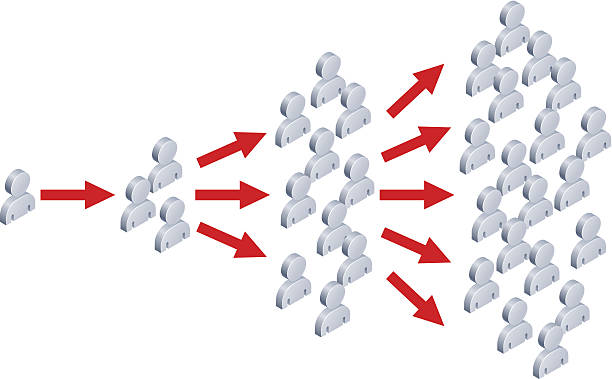
Today’s topic is one that’s bugged me since I embraced this pagan/polytheist life some twenty-five years ago… the topic of sharing what you’ve found to be good in your life, the topic of bringing others into a similar mindset, the topic of: proselytizing. Seriously, y’all… this one has never made sense to me. 

“Pagans (of whatever flavor) don’t proselytize!” 

I’m SURE y’all pagan folx have heard this bit of lore floating about the community-at-large, right? I’m gonna roll with the assumption that most of us have heard this trope before. 

“If people want to know our mysteries, they will find us (or, they’ll leave your arrogant, gatekeepin’ ass out of it, and buy a book or go online and Google that shit).” 

Most pagans find it tacky to “sell” their religion, and I can see why if one views religion as a commodity, or something to be sold. I’ll go out on a limb and assume that those same pagans are the folx who begrudge trained religious professionals from making a meager living doing the work they’re called to do. They want to keep their resources for themselves in the same way they selfishly want to horde their religion, commodifying it and using it for their own social advantage. They don’t want to grow consciousness or community… only selfish fame, and egoic “power”. After all, there are no rules in our overarching practice that dictates we share our faith and viewpoints and perspectives, therefore, since we don’t have to, we don’t. (#YoureNotTheBossOfMe #EgoPaganism)

Sure, there isn’t an obligation built-in to our religion that says we’re responsible for saving souls, or witnessing to strangers, or going on mission to spread the good news… and because we don’t HAVE to, only a small few get around to even mentioning the very thing which we claim to be most sacred to us. I’d wager that in more than 50% (my guess would be closer to 75-85%) of pagan-identifying households, from the 1970’s to the 1990’s, many parents kept their pagan-ing as something adults did, and they never even offered their children religious guidance (except for, perhaps, the non-committal “explore all things” and “I don’t want to shove my religion down my kids’ throat” bullshit), even though they themselves have claimed to have found their own long-lost lifepath. Gods be praised, many pagan parents of today are sharing our ways and views with their children, and others in the greater community. I’d hope we can agree that our ways are needed more than ever during this time in history. 

What I’m saying is that I guess I’m just too privileged to understand why NOT sharing your religion with those in need of it’s guidance and reassurances is a good thing. I’ve always been of the mind that if something is so badass and special, why wouldn’t you want others to know how awesome it is too, and for them to try it themselves? I guess it’s the way of my people (Louisiana and New Orleans folx) to share in the things that raise us up, and make us all who we are as the special-individual in the collective-unique. Why WOULDN’T someone want to share that? 

From my perspective, and only my perspective, mind you… I find the act of not sharing that which is most sacred to you inhospitable, miserly, and cowardly. Withholding that which could help someone out of a fog, and empower them to not get lost in the future is foolish, short-sighted, and barren of spirit. In most cases, not sharing those sacred things goes against the spirit of Hospitality, and is an act that is lacking of virtue. That’s what I tell myself when I’m not feeling like sharing my poly-consciousness with others. 

I know the above words are hard words, but please understand that my JOB as a religious professional is to get people remembering, thinking, growing, evolving, and thriving… and use the lessons and truths of poly-consciousness, ancient lore, cosmotheism, Stoicism, and whatever else I can get my hands on to embody my vocation, and do that job. 

So, yes… please spread the word of that which makes you a better you, that which aligns you with a complex, confusing reality, and that which could potentially heal the world. 

Remember, the word proselytize comes from the Greek proselytos, which means “a convert, a stranger, one who has come over”, but it also means “having arrived”. What we’re doing when we freely and with joy share that which is sacred to us, is try and help another person “arrive” at similar awakenings and understandings that we have. We’re offering a hand for them to take the next step in their own becoming. 

If we can’t share that which is most sacred, we must ask ourselves: are we sure that it’s not our egos which we’re holding as most sacred? Are we holding our fears as most sacred? Why are we religion-ing in the first place, if not to tune-in to something greater than ourselves… 

… and why would we want to selfishly keep that for ourselves, or shroud it all in mystery? 

After all, it’s not really yours if you can’t give it away. 

(See y’all tomorrow) 

Give People the Benefit of the Doubt (Day 288)

10/15/2019

 
Everything turns on your assumptions about it, and that’s on you. You can pluck out the hasty judgement at will, and like steering a ship around the point, you will find calm seas, fair weather, and a safe port.”
Marcus Aurelius, Meditations, 12.22

Is it inherently virtuous to give someone the benefit of the doubt?

Giving someone the benefit of the doubt is Hospitable, Courageous, Wise… it would seem that giving someone the benefit of the doubt IS inherently virtuous, right? 

We cannot forget, however, that in the pursuit of virtue, there is more than just embodying said virtue, OR not embodying said virtue. If we give someone the benefit of the doubt with the foreknowledge of past hurts and traumas, what we’re offering to them is the “idiot” version of this virtue. Also, if we give someone a break, knowing they’ve changed, then use that “break” against them for sociocultural leverage, then we’d be “weaponizing” the virtue. 

Perhaps giving someone the benefit of the doubt, much akin to being Wise, or having Integrity, or embodying other virtues… has room for ego’s selfish influence. 

Seek virtuous kindness without ego. It's harder than you think. 

​If you think it isn't, that's your ego talking. 

(See y’all tomorrow)

Don’t get Mad. Help. (Day 287)

10/14/2019

 
Picture
Image by Sasin Tipchai from Pixabay

Don’t get mad? As if. Help the ones who just pissed me off? Hardly. 

The state of the union as it stands is such a rich environment to become mad, right? There’s a lot of angry going around these days. 

So many blogs, videos, tweets, Facebook posts, etc, etc, etc… so much mad in the world. 

How much of our anger helps? Any? How much gets done because we’re angry? Do we NEED to become angry in order to help? Does our anger shut down our kindness-engine? 

Sit with these questions. Start discussions at work. 

Those things would be helpful, yeah? 

(See y’all tomorrow)

Revenge is a Dish best Not Served (Day 286)

10/13/2019

 
Vengeance wastes a lot of time and exposes you to many more injuries than the first that sparked it. Anger always outlasts hurt. Best to take the opposite course. Would anyone think it normal to return a kick to a mule or a bite to a dog?”
Seneca, On Anger, 3.27.2

​Be the person the dishonest don’t believe exists: an honest & integrity-filled person. 

Be the person the miserly don’t believe exists: a hospitable & generous person. 

Be the person the cruel don’t believe exists: a kind & compassionate person. 

Don’t prove them right. 

(See y’all tomorrow) 

Always Love (Day 285)

10/12/2019

 
Picture
Image Credit: Ursula Vernon

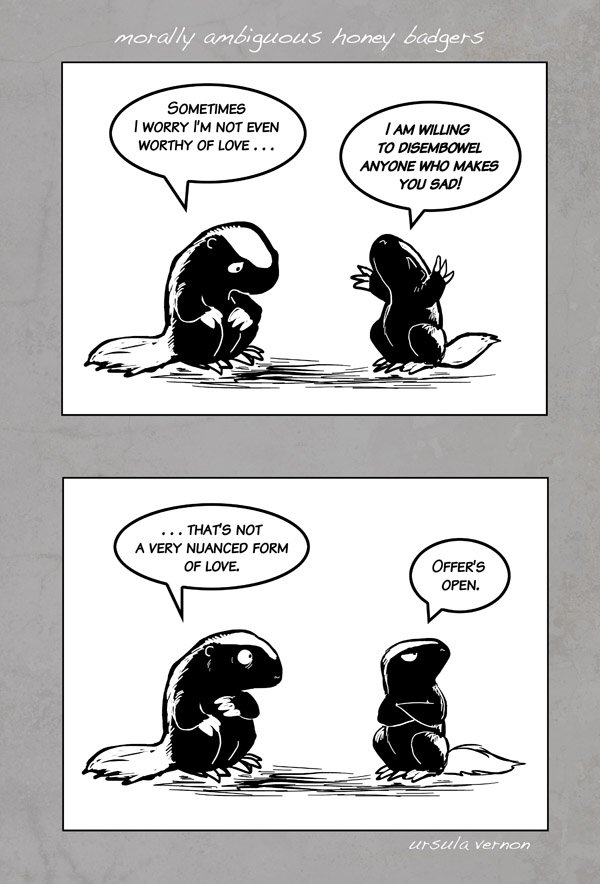
Hecato says, ‘I can teach you a love potion made without any drugs, herbs, or special spell - if you would be loved, love.’”
Seneca, Moral Letters, 9.6

Can we think of a situation in which divisiveness and hatred helps? Really helps, and not the kind of help that only serves to bolster our egos and righteousness. Can we think of such a circumstance?

After sitting for an hour or so this morning, I couldn’t.

However, when applying love and a desire to understand those same circumstances, it seemed the end point of “helping the situation” came more easily into being.

Funny that this topic comes up on the very day that Rev. Bee and I will be attending an elevation ceremony of someone with whom there was once much love shared. Now, there is none… but after today’s lesson, I trust that if no one makes the first move in the spirit of love, the rifts will never be healed. Gods be good, I can be a conduit of that love… be it applied to another being, or to myself.

Maybe love isn’t all one needs, contrary to the opinion of The Beatles…

… but I believe that while love in it’s stand-alone form isn’t all one needs, it’s presence and necessity in our lives and relationships is absolute. Whether focused inwardly, outwardly, or any combination therein, always love.

Always.

(See y’all tomorrow)
<<Previous
Forward>>

    About the Blog

    Awakening the desire to explore Stoicism, and how it relates to his existing beliefs, Rev. William committed to working through the text, The Daily Stoic, a year-long journey to awaken the Stoic mind. 
    How things are structured can be found in the first post. 

    About the Author

    Born and raised in New Orleans, Louisiana, Rev. William attended Naropa University in Boulder, Colorado where in 2007 he graduated with a degree in Religious Studies, minoring in Psychology. Currently residing in Longmont, CO, he is one of the Priests and founder of Mountain Ancestors Grove.  He spends his time playing mandolin (and some guitar), writing, engaging in LGBTQIA+ advocacy and education, community service, and sharing a larger vision of how a polytheist perspective can lead to greater human understanding, acceptance, and gods be good, peace. 

    Archives

    January 2020
    December 2019
    November 2019
    October 2019
    September 2019
    August 2019
    July 2019
    June 2019
    May 2019
    April 2019
    March 2019
    February 2019
    January 2019
    December 2018

    Categories

    All

    RSS Feed

Powered by Create your own unique website with customizable templates.